“For me, wealth isn’t about accumulating money – it’s about the ability to make things happen. That can be financial, but it can also be values-driven. People with financial means should use that capacity to support innovative, sustainable projects that create long-term positive impact.”
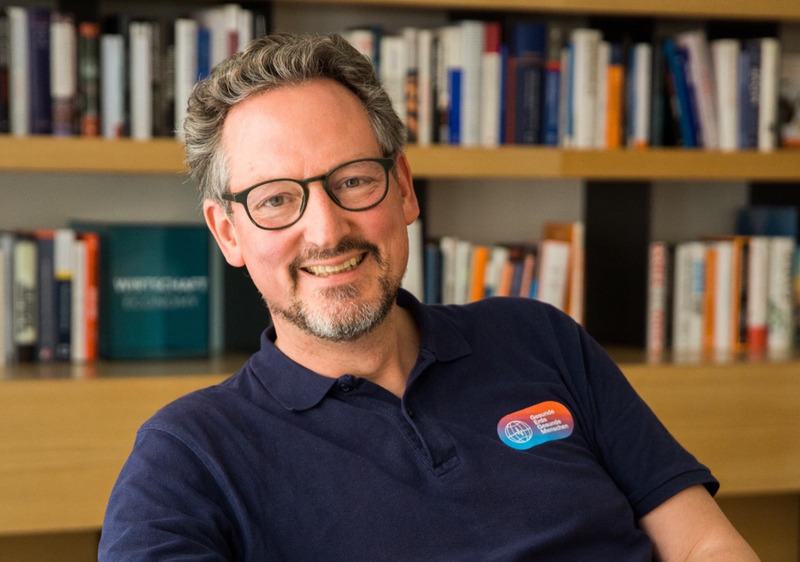
Dr. Eckart von Hirschhausen in conversation.
First published by change – the Bertelsmann Stiftung magazine, July 5, 2024
What does it mean to take responsibility for our own health — and the health of our planet? change spoke with Dr. Eckart von Hirschhausen about the power of social engagement, the role of sustainable investing, and his vision for a future worth living in. For Dr. Eckart von Hirschhausen, human health and climate protection are inseparable As a physician and science journalist, he advocates for planetary health through his foundation Gesunde Erde – Gesunde Menschen (Healthy Planet – Healthy People) change met him at an event for NextGen impact investors organized by the German Federal Initiative for Impact Investing and the Bertelsmann Stiftung. In this interview, he explains why climate action can’t wait, and shares practical steps each of us can take to help build a better future.
Dr. von Hirschhausen, how can we protect our own health – and the planet’s – in our everyday lives?
“Health doesn’t start with a pill, a surgery, or an MRI. It starts with the air we breathe, the water we drink, the plants we can eat, and temperatures we can actually live with. And all of that is currently at risk. That’s why we should pay attention to three things: our ecological footprint, our handprint, and our heartprint. Small steps matter – biking instead of driving, taking the train instead of a flight. Getting involved with NGOs or foundations can make a huge difference too. And it’s just as important to talk about the things that worry us and to celebrate the people who are working on solutions.”
“The most important thing any one of us can do right now is this: don’t stay alone. Every morning, ask yourself: ‘Who can I inspire today — someone who might be able to move even more than I can?’”
- Dr. Eckart von Hirschhausen, physician, science journalist, and speaker
You talk about footprint, handprint, and heartprint. What do you mean by that?
“The footprint reflects the negative impact we have on the planet – the resources we consume and the emissions we produce. The handprint captures the positive impact of our actions, like supporting sustainable projects or driving change through the choices we make. And the heartprint represents our emotional and social contribution: how we inspire others when we talk openly about our worries and hopes, and when we lift up the people who are already creating solutions. All three are essential if we want to build a fair and sustainable future.”
Where do you see the greatest need for action?
“We need to move decisively away from fossil fuels, scale renewable energy, and finally put a meaningful brake on CO₂ emissions. Right now, the damage caused by one ton of CO₂ is still higher than what companies pay for it, and that’s simply not logical. Take Denmark as an example: raising the CO₂ price suddenly made sustainable investments more attractive for businesses. We need that same kind of reality check here. We should be asking what the climate crisis is already costing us, and what it will cost if we keep going as we are. It becomes clear very quickly that the investments we need to make today to protect our basic living conditions are far smaller than the price we’ll pay if we do nothing.”
Do wealthy people carry a special responsibility?
“For me, wealth isn’t about accumulating money – it’s about the ability to make things happen. That can be financial, but it can also be values-driven. People with financial means should use that capacity to support innovative, sustainable projects that create long-term positive impact.” Because what is wealth worth if we end up living on a planet that’s no longer livable? Germany is one of the richest countries in the world. We have the means to lead on climate action. Public debate often defaults to the ‘safe’ option, but the younger generation understands something crucial: the quickest way to destroy the status quo is to cling to it. That’s why we can’t wait for political action alone. We all need to get involved.”
“The younger generation understands something crucial: the quickest way to destroy the status quo is to cling to it. That’s why we can’t wait for political action alone. We all need to get involved.”
- Dr. Eckart von Hirschhausen, physician, science journalist, and speaker
Do you have tips for contributing to climate and environmental action even without significant wealth?
“The most important thing any one of us can do right now is this: don’t stay alone. Every morning, ask yourself: ‘Who can I inspire today – someone who might be able to move even more than I can?’” One of the reasons why I launched the “Healthy Planet – Healthy People” foundation was this realization: it’s incredibly hard to save the world in your spare time when others are destroying it full-time. But everyone can help build a shared vision of a livable future, by getting involved in whatever way fits their life. That could mean supporting sustainable projects through community groups, churches, local initiatives, or foundations.”
What kind of world do you hope to live in ten years from now?
“As a physician, my work centers on health, and I see a lot of anxiety and uncertainty, both among scientists and among people who care deeply about these issues. The real question is: what more has to happen before we finally wake up? Ten years from now, I want to see Europe become the first climate-neutral continent. That would be one of the greatest success stories since the post–World War II peace efforts. Other regions are watching, and they’ll only follow if we succeed. I want to look back in ten years and know I did everything I could to help push things in the right direction. We all have a chance to make real change right now, and we should take it.”
Thank you for the conversation!
If you want to learn more about how we can create positive change together, take a look at Sustainable Social Market Economies program. The Bertelsmann Stiftung is working to align economic success and social inclusion with ecological responsibility.