Why measuring potential impact matters for startups and impact investors – and how Borderstep’s digital GHG & Impact Estimator helps turn impact assumptions into transparent, data-driven projections.
Dr. Thomas Neumann, Senior Researcher Sustainable Entrepreneurship at the Borderstep Institute
Many startups want their products and services to make a positive difference in addressing environmental and social challenges. The IMMPACT Guide provides a standardized framework to help them define their impact goals, map out how they plan to achieve them, and make their underlying assumptions transparent. But at some point, startups need to go beyond describing their intended impact. They need to demonstrate how they plan to measure it and, wherever possible, put numbers behind it. This is becoming increasingly important – not just for managing impact internally, but also for communicating with impact investors, funding organizations, and customers.
Turning ambition into action
For startups, that’s easier said than done. Traditional sustainability assessments are typically designed for established companies. Early-stage startups, however, often lack historical data, well-developed value chains, and the resources needed for in-depth analysis. What’s more, impact investors are generally less interested in what a startup has already achieved than in the impact it could generate in the years ahead.
At Borderstep, we’ve spent more than a decade researching this challenge and developing practical solutions. A major milestone came in 2020 with the development of DIN SPEC 90051–1, the Standard for the Sustainability Assessment of Startups. While the standard initially focused largely on qualitative assessments, it has since become an important foundation for developing practical tools designed specifically for startups.
From impact goals to measurable potential
One of the latest results of this work is the GHG & Impact Estimator (Greenhouse Gases & Impact Estimator), developed in collaboration with our spin-off, ImpactNexus. This free, browser-based tool helps startups identify and quantify their potential to reduce greenhouse gas emissions. Unlike many traditional sustainability assessment tools, it focuses on what a startup could achieve in the future rather than what it has already accomplished. The key question is: What impact could the startup’s products and services generate over the next five years if the business grows as planned? This forward-looking perspective is especially valuable for impact investors evaluating the potential impact of their investments.
Despite its name, the GHG & Impact Estimator isn’t just about climate impact. Its capabilities have expanded considerably, allowing startups to systematically assess and quantify a wide range of economic, environmental, and social impacts. Companies can choose from more than 12,000 impact goals and tailor them to their own impact models. At its core is the Theory of Change, a framework that connects activities to intended outcomes and impact. Because this approach is deeply integrated into the tool, startups can build directly on the work they’ve already done with the IMMPACT Guide.
The GHG & Impact Estimator also includes features designed to make impact assessment more manageable. These include templates such as the GHG Estimator for generating initial estimates of greenhouse gas impacts and Impact Carry for structured impact reporting aligned with impact investing requirements. Users also benefit from detailed explanations, clear guiding questions, AI-powered assistance in selecting appropriate units and data points, and access to life cycle assessment databases.
BetterSOL offers a concrete example of how this works. Founded in 2022, the startup tests and resells used solar panels, reducing the need for energy- and resource-intensive manufacturing of new panels. For every kilowatt-peak of solar panels reused, approximately 800 kilograms of CO2 emissions are avoided. By combining this figure with projected business growth, BetterSOL can estimate how its potential contribution to climate change mitigation could increase over the coming years. Visualizing these projections makes the startup’s potential impact easier to understand, communicate, and use – both for internal decision-making and in conversations with investors.
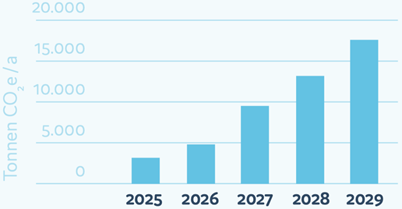
Figure: Example output from the GHG & Impact Estimator for BetterSOL, showing its estimated potential to reduce greenhouse gas emissions from 2025 to 2029. Source: Green Startup Report 2025.
Support for estimating impact and checking assumptions
The GHG & Impact Estimator is designed to be user-friendly and largely self-explanatory. Still, additional guidance can be especially valuable for startups quantifying their impact for the first time or looking to assess the plausibility of their assumptions and results. That’s why we’re currently offering free one-on-one coaching sessions and workshops through Train4Impact, a project funded by the German Federal Ministry for Economic Affairs and Energy (BMWE).